Manrique
Jameos del Agua
A subterranean salt lake and lava openings form the setting for César Manrique's cultural centre
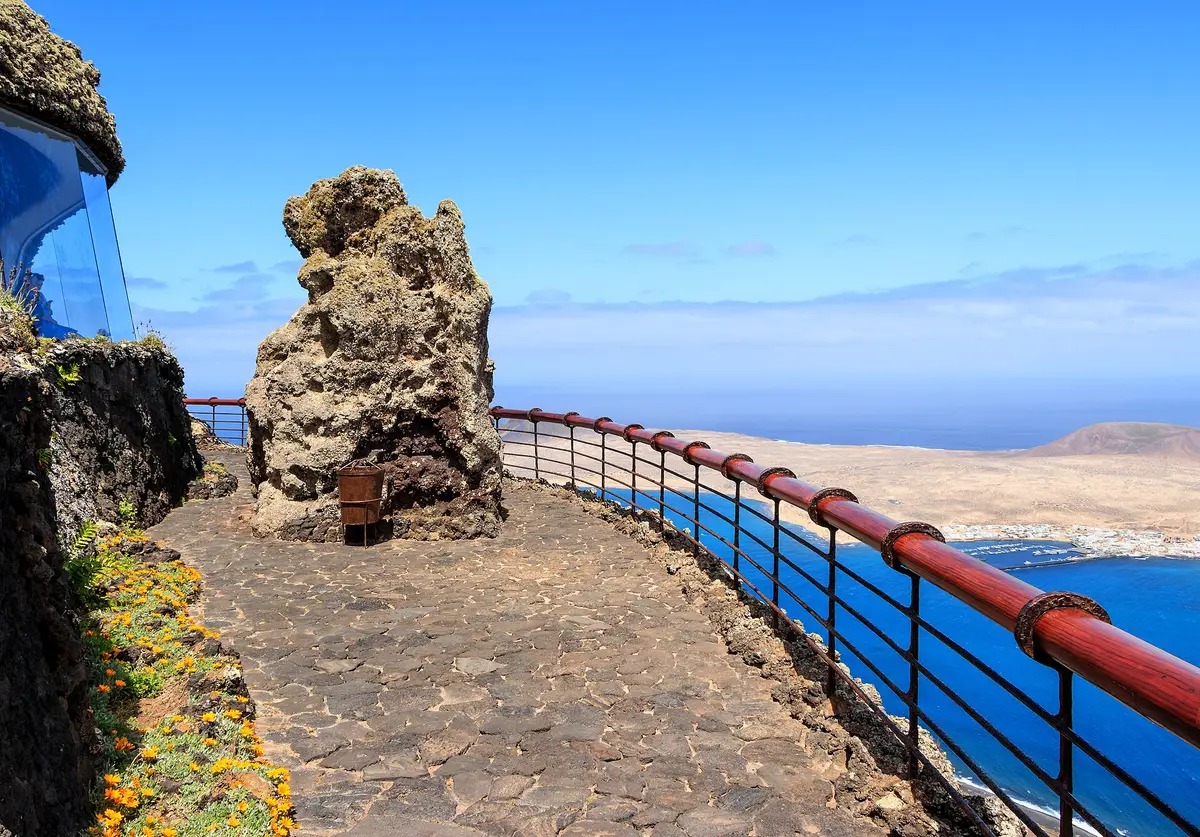
Behind a heavy stone exterior, Mirador del Río opens into vaulted rooms overlooking the water towards La Graciosa. César Manrique's viewpoint sits on an approximately 475-metre-high escarpment in northern Lanzarote. People come for the island views, but the winding entrance, broad windows and building's integration into the rock are equally central to a visit.
The approach gives little away: a heavy stone skin disguises the building against its surroundings, leaving it barely visible from outside. Inside, a winding corridor leads into spacious vaulted rooms. Large glass windows, described as the eyes of the Mirador, turn the view across the water into the main feature of the interior. The change from enclosed passage to broad outlook is a concrete example of Manrique's way of working with a site rather than placing a conspicuous building on it. Created between 1971 and 1973, the complex includes a balustraded café, a souvenir shop and a viewing platform at the top, all integrated into the lava rock. Eduardo Cáceres and Jesús Soto carried out the technical realisation of Manrique's design, and the viewpoint was inaugurated in 1973. A visit therefore involves more than reaching an outdoor lookout: the corridor, vaulted spaces, glazing and exterior stonework are part of the attraction.
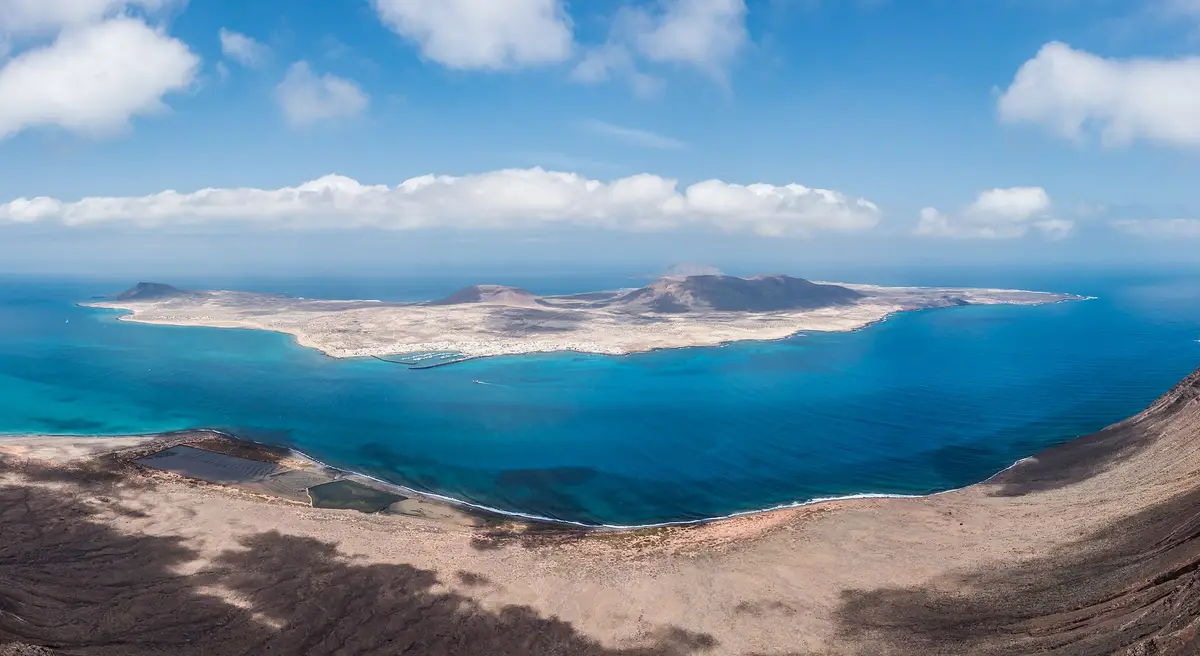
Mirador del Río stands on the Batería del Río escarpment, looking across the Strait of El Río towards La Graciosa. The height gives a broad view over the water and the island beyond, while the windows provide an indoor place from which to take it in. Visibility determines how much of the wider island group can be seen. On clear days, Montaña Clara and Roque del Oeste appear beyond La Graciosa, with Alegranza furthest away. Together they belong to the Chinijo Archipelago. The surroundings of the viewpoint are a protected natural area, so the setting is not simply a backdrop to the building. Unlike Jardín de Cactus, where attention stays within a terraced former quarry, this Manrique project directs the eye out across a much larger landscape. The café and upper platform give the visit different stopping points, but the defining feature remains the relationship between the concealed building and its open outlook.
The main reason to choose Mirador del Río is the combination of architecture and an outward-facing island view. The building does not announce itself with a large exposed façade: its stone covering blends into the escarpment, while the interior opens towards La Graciosa through broad glass windows. That makes it a different experience from Jardín de Cactus, another Manrique project where the plants, terraces and windmill form the main subjects of the visit. Here, the corridor and vaulted rooms provide the architectural interest, and the water and islands supply the wider setting. Clear conditions matter particularly if seeing the smaller members of the Chinijo Archipelago is your priority. Even when the furthest islands are not visible, the building still has specific features to examine, including its heavy exterior covering and the transition from the winding passage to the windowed rooms. The café, shop and upper viewing platform belong to the same rock-integrated complex rather than standing apart from the design.
César Manrique created Mirador del Río between 1971 and 1973, with Eduardo Cáceres and Jesús Soto responsible for its technical realisation. Its construction brought a café, shop and viewing platform into a location where an exposed building could easily have dominated the escarpment. Instead, the heavy covering of stone makes the structure difficult to distinguish from the surrounding ground. Inside, the design is much less concealed: the spacious vaulted rooms and large windows establish a clear focus on the view across the strait. The contrast between those interior volumes and the subdued exterior is what distinguishes the project from a simple viewing platform. The winding entrance also means the outlook is not presented immediately at the door. The building was inaugurated in 1973, and its surroundings have been declared a protected natural area. Together, the protected setting and rock-covered construction explain why the architecture remains closely tied to the land beneath and around it.


The main view looks across the Strait of El Río towards La Graciosa. In clear conditions, you can also see Montaña Clara and Roque del Oeste, with Alegranza further away. These islands form part of the Chinijo Archipelago. The large windows frame the outlook from inside, and the complex also has an upper viewing platform.
No, it is a rock-integrated building with vaulted rooms, large windows, a café, a souvenir shop and an upper platform. A winding corridor leads into the main interior spaces. Designed by César Manrique and inaugurated in 1973, it is as much an architectural visit as a place to look across to La Graciosa.
César Manrique created Mirador del Río, while Eduardo Cáceres and Jesús Soto carried out its technical realisation. Work took place between 1971 and 1973, and the viewpoint was inaugurated in 1973. Its stone-covered exterior, winding corridor and broad windows show how the building was designed around its position above the Strait of El Río.
Mirador del Río sits on an approximately 475-metre-high escarpment called Batería del Río. Its position provides a broad outlook over the Strait of El Río towards La Graciosa. The building includes indoor viewing rooms and an upper platform, while the visibility of the more distant Chinijo islands depends on clear conditions.
Keep going
A subterranean salt lake and lava openings form the setting for César Manrique's cultural centre
Enter a drained lava tube with illuminated cave walls and a concert hall near its entrance
A ferry ride from Órzola leads to sandy streets, volcanic hills and a coastline without paved roads