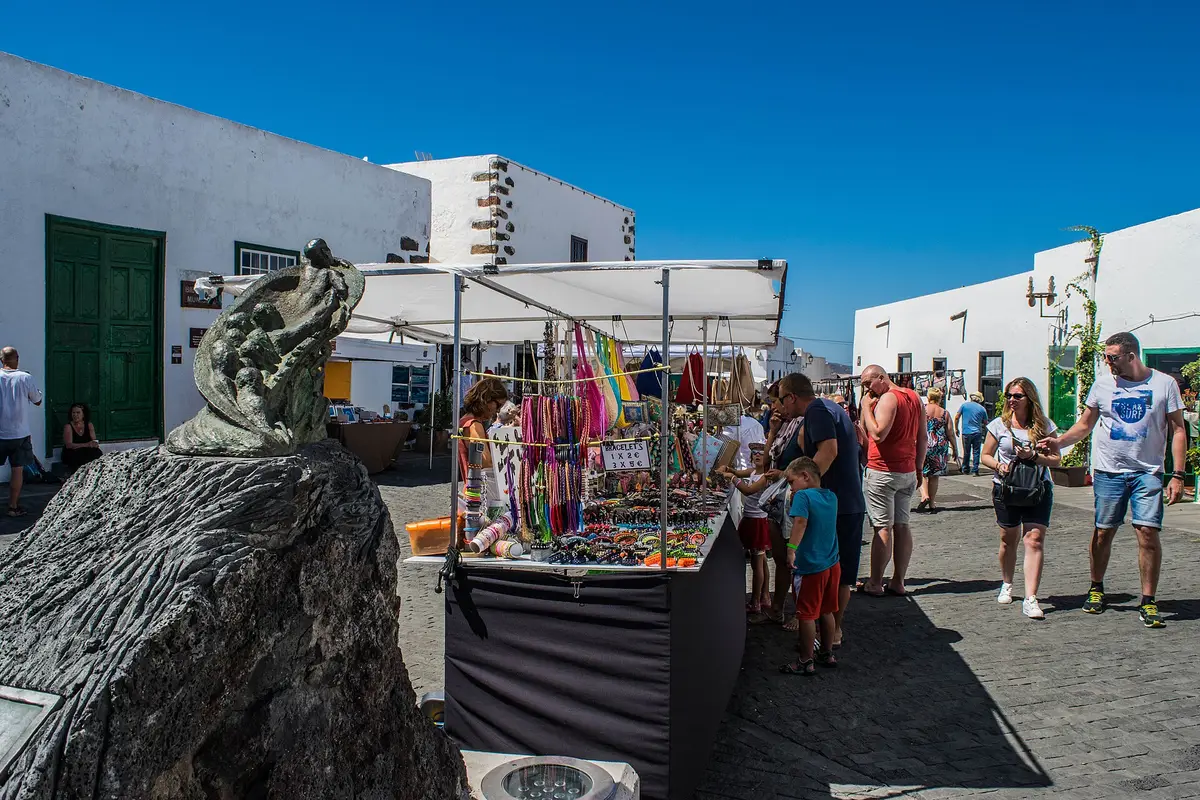
In north-central Lanzarote, Teguise is the island's former capital, with a historic centre of whitewashed houses, substantial stone doorways and a church tower above the rooftops. Its Sunday market brings a different rhythm to the streets. People come for the old town, the stalls and the volcanic hill crowned by Castillo de Santa Bárbara.
The historic centre
Teguise was Lanzarote's capital before Arrecife took over that role. Its old centre still has the buildings of an administrative and religious town rather than the layout of a coastal resort: substantial houses, former convents and a church facing an open square. Whitewashed walls are broken up by dark volcanic-stone surrounds, wooden doors and shuttered windows. Looking along the streets, the church's pale bell tower provides a useful landmark above the lower roofs.
Repeated pirate attacks shaped the town's history, while later damage and rebuilding mean the church is not an untouched survival from the earliest settlement. The contrast between its white surfaces and exposed stonework is more immediately apparent than those changes in date.
A visit centres on walking through the squares and connecting streets, stopping at buildings whose doorways and façades reward a closer look. Former religious buildings also have cultural uses, although access to individual interiors can vary. Away from market day, the architecture is easier to see without stalls and shoppers filling the foreground.
Sunday in the streets
The Sunday market spreads through the historic centre, turning streets and squares into rows of stalls. Clothing, jewellery, leather goods, souvenirs and craft items sit alongside food stalls. The stock is mixed: this is a broad visitor market, not exclusively a showcase for things made on Lanzarote. Anyone looking specifically for local work will need to ask about the maker and where an item was produced.
The market changes the experience of the town as much as it changes what there is to buy. Stalls interrupt views along the old streets, shoppers gather around displays, and cafés become places to pause between circuits of the centre. For visitors interested in browsing and street activity, Sunday gives the visit a clear focus.
For architecture, photographs of the buildings or a less crowded walk, a non-market day is the better choice. The same squares and stone-framed façades remain, but they are no longer the backdrop to a shopping trip. Neither version needs to be treated as the definitive Teguise; they offer noticeably different visits.
The castle above town
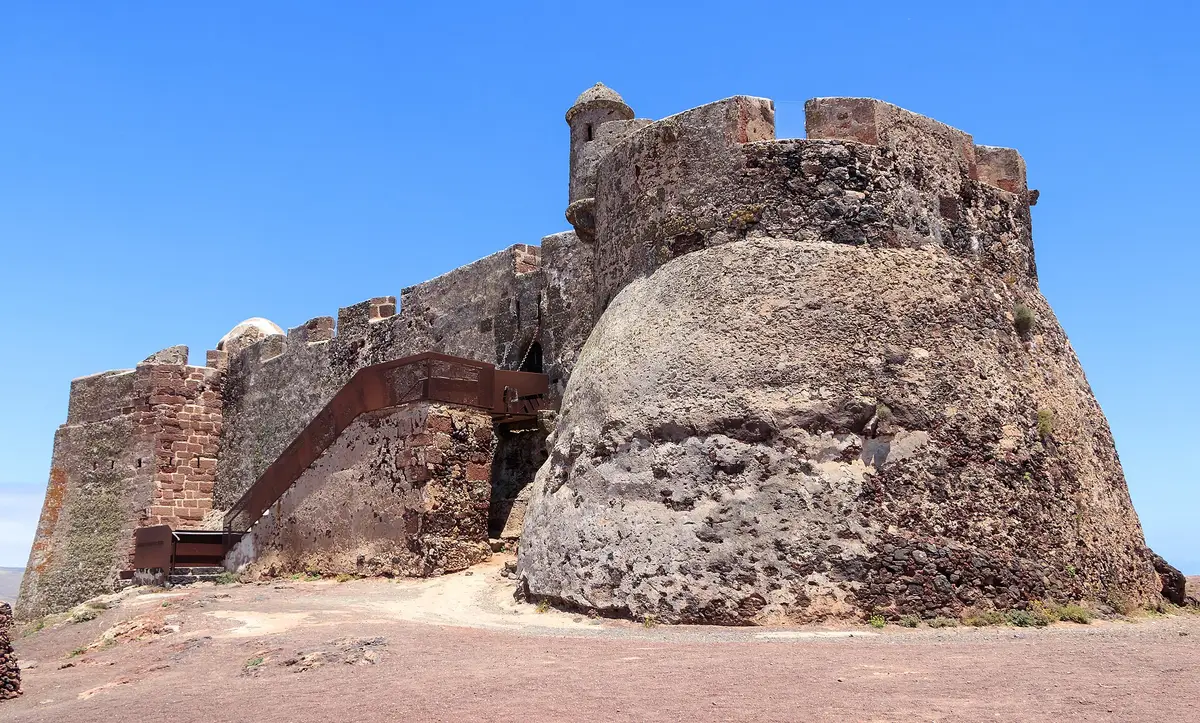
Castillo de Santa Bárbara stands on a volcanic hill above Teguise, separate from the streets of the historic centre. Its raised position explains its defensive purpose: the settlement and the surrounding approaches could be watched from above. Against the hill, the castle's squat stone walls form a different silhouette from the church tower below.
The building belongs to the history of raids that affected Teguise and other settlements on Lanzarote. From the outside, its compact form and substantial masonry make that role easier to understand than it is among the houses and cafés in town. The volcanic setting matters too: this is a fortification placed on an existing natural lookout, not a grand residence surrounded by gardens.
A castle visit is a separate uphill excursion rather than another stop on a level circuit of the centre. Interior access should be checked before heading up. Even when planning around the exterior, wind, sun and the exposed ground deserve more consideration here than among the sheltered town streets.
Teguise or Costa Teguise
Despite the shared name, Teguise and Costa Teguise are distinct places. Teguise is the inland historic settlement; Costa Teguise is the coastal resort. That difference is useful when choosing where to spend a day, and particularly when checking an address or arranging transport. A booking that says Costa Teguise does not put you in the old town described here.
Teguise's appeal is concentrated in its streets, squares, historic buildings and market rather than a seafront. It suits a visit built around walking, looking at architecture and stopping for something to eat. The castle adds a separate outing above the centre, but the town itself is not a beach destination.
Arrecife provides the other relevant comparison: it replaced Teguise as the island's capital. Here, the former seat of government survives as a much smaller settlement, with the old centre providing the main reason to come. Choosing a quiet weekday or the Sunday market has a greater effect on the visit than trying to cover a long checklist of sights.
What to look for
- Look for dark volcanic-stone door surrounds against whitewashed walls
- See the church tower rising above the historic centre
- Browse clothing, jewellery and craft stalls at the Sunday market
- View Castillo de Santa Bárbara on its volcanic hill
- Walk the squares without market stalls on a weekday
Teguise in photographs

Questions about Teguise
What day is Teguise market?
Teguise's street market takes place on Sunday. Stalls occupy the historic centre, selling a mixture of clothing, jewellery, souvenirs, craft items and food. It is the livelier time to see the town, but not the easiest for looking closely at the buildings. A non-market day gives a quieter view of the same streets and squares.
Is Teguise the same as Costa Teguise?
No, Teguise is the inland historic town, while Costa Teguise is a separate coastal resort. The shared name can cause confusion when checking accommodation or planning transport. For the old streets, Sunday market and Castillo de Santa Bárbara, the destination is Teguise rather than Costa Teguise.
Is Teguise worth visiting outside market day?
Yes, a non-market day is better suited to seeing Teguise's architecture and walking its centre without the market crowds. The whitewashed houses, stone doorways, church and squares are the main focus. Individual buildings may not always be open, so the visit should not depend entirely on gaining access to their interiors.
Was Teguise the capital of Lanzarote?
Yes, Teguise was Lanzarote's capital before that role passed to Arrecife. Its substantial houses, religious buildings and public spaces reflect that earlier importance. The castle above the village also connects it to the island's defensive history, when pirate raids were a recurring threat to settlements.
Keep going
Close to here
Manrique
Fundación César Manrique
The foundation continuing César Manrique's conservation work on Lanzarote
Museum
Castillo de Santa Bárbara
A fortress on Guanapay volcano’s crater edge, built to shelter Teguise’s inhabitants and now housing the Piracy Museum