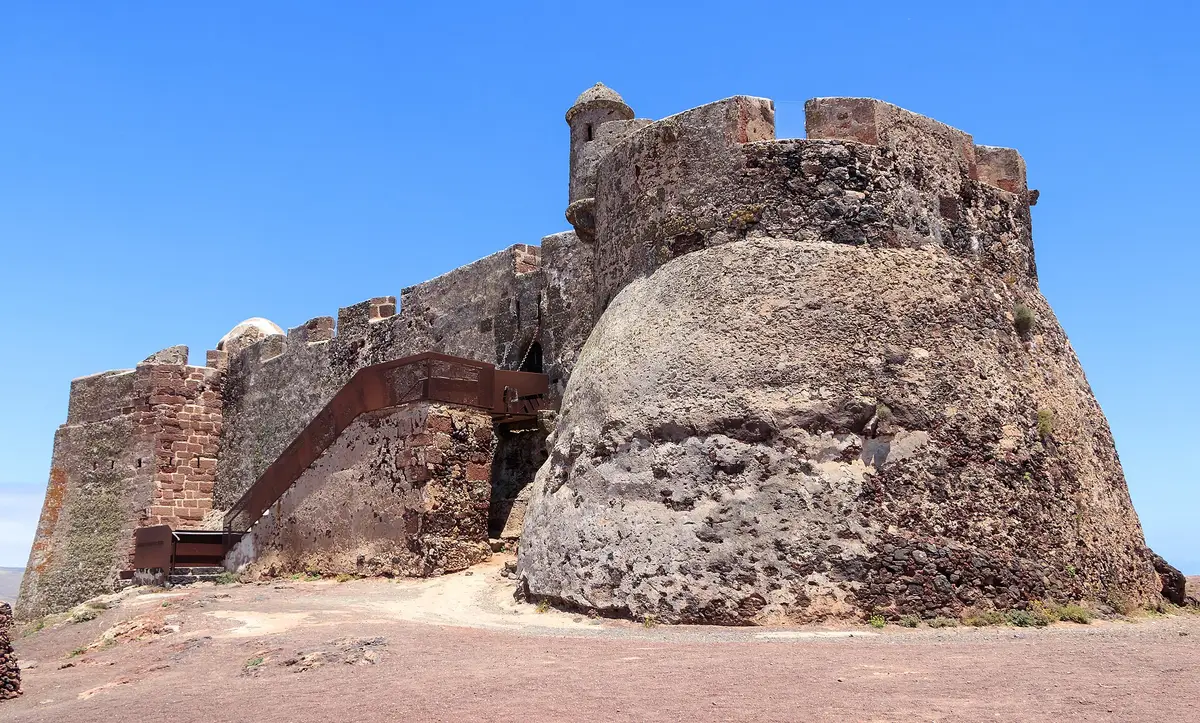
Above Teguise, Castillo de Santa Bárbara stands on the edge of Guanapay volcano’s crater, about 1 kilometre from the town. The fortress is open to the public and houses the Piracy Museum. Its setting and history are closely linked: this was a coastal lookout and a refuge for the inhabitants of Lanzarote’s former capital.
Planning a whole day from a base nearby? See things to do in Costa Teguise.
A watchtower turned fortress
The castle began as a simple watchtower in the 15th century, commissioned by Sancho de Herrera on the orders of Lancelotto Malocello. Its purpose was to guard the coast. The position above Teguise placed that lookout on the edge of a volcanic crater, rather than beside the harbour or within the town itself.
In the 16th century, Leonardo Torriani had the tower converted into a fortress. Teguise was then Lanzarote’s capital, and the enlarged building was intended to shelter its inhabitants during enemy raids, particularly pirate attacks. Construction was completed in 1576, but a Berber attack in 1586 led to reconstruction. The fortress therefore belongs to a history of repeated defensive work, not simply a single building campaign.
Officially named Castillo de Santa Bárbara y San Hermenegildo, it combines a volcanic location with a practical role in the town’s defence. For a visitor today, the concrete features are the fortress itself, its position atop Guanapay and the crater edge beneath it. The museum inside addresses the piracy that helped shape the building’s purpose.
From artillery to museum
Santa Bárbara’s military importance declined in the 17th century, when a substantial fortification was built in the port of Arrecife. All artillery was removed from the castle. By the 19th century, pirate attacks had ceased and the fortress was obsolete as a defensive structure.
Its later uses were less predictable. A military pigeon loft was established here in 1899, and the fortress passed to the municipality of Teguise in 1913. These changes took the building from coastal defence to military communications and then municipal ownership, long before its present role as a public museum.
Between 1991 and 2011, the castle housed an ethnographic museum of Canarian immigrants. It was declared a cultural heritage site in 1993. The Piracy Museum, also called Museo de la Piratería, subsequently replaced the earlier museum and is the attraction housed inside today. A visit therefore brings together the historic fortress and a museum whose subject connects directly with its former purpose: protecting Teguise’s inhabitants during raids.
The crater-edge setting
The location is an essential part of what is here: a fortress atop Guanapay volcano, standing at the edge of its crater. Teguise lies about 1 kilometre away, so the castle is separate from the town it was built to protect. It is not a defensive building absorbed into streets or a harbour frontage; the volcano is its immediate setting.
That relationship between town, lookout and refuge runs through the castle’s history. The original tower guarded the coast, while the later fortress provided shelter for the inhabitants below. The building’s role changed as stronger defences elsewhere took over, but its position remained the same.
Today, the public attraction occupies that historic structure rather than a separate museum building. The fortress, crater-edge location and Piracy Museum are the concrete reasons to come. A visit can sit alongside time in Teguise, with the castle providing the defensive counterpart to the former capital it once served.
A changing public role
The museum now inside the castle is not the first to occupy it. From 1991 to 2011, the fortress housed an ethnographic museum of Canarian immigrants. Its replacement by the Piracy Museum shifted the subject from migration to the attacks that had helped determine the building’s original defensive role.
The sequence of uses is unusually varied for a single structure: watchtower, refuge, artillery position, military pigeon loft and museum. Municipal ownership began in 1913, after the fortress had already lost its purpose in coastal defence. Cultural heritage designation followed in 1993, during its earlier museum period.
For visitors, the present arrangement is straightforward: the fortress is open to the public and contains the Piracy Museum. The historic building is part of the attraction in its own right, rather than merely a container for an unrelated collection. Its reconstruction after the attack of 1586 also connects the museum’s subject to an event in the castle’s own history.
What to look for
- See the fortress on Guanapay volcano’s crater edge
- Visit the Piracy Museum inside the former defensive fortress
- See the castle completed in 1576 and reconstructed after 1586
- Combine the castle with time in nearby Teguise
- Trace the building’s change from coastal watchtower to public museum
Castillo de Santa Bárbara in photographs


Questions about Castillo de Santa Bárbara
Where is Castillo de Santa Bárbara?
Castillo de Santa Bárbara stands atop Guanapay volcano, on the edge of its crater, about 1 kilometre from Teguise on Lanzarote. It is outside the town rather than among its streets. The location reflects its original purpose as a coastal lookout and, later, a refuge for the inhabitants of the former capital.
Can you go inside Castillo de Santa Bárbara?
Yes, the fortress is open to the public and houses the Piracy Museum, also known as Museo de la Piratería. The museum occupies the historic defensive building on Guanapay volcano. It replaced an ethnographic museum of Canarian immigrants, which was housed in the castle between 1991 and 2011.
Why was Castillo de Santa Bárbara built?
The fortress was built to shelter Teguise’s inhabitants during enemy raids, especially pirate attacks. It developed from a 15th-century coastal watchtower commissioned by Sancho de Herrera. Leonardo Torriani had the tower converted into a fortress in the 16th century; construction finished in 1576, followed by reconstruction after a Berber attack in 1586.
What museum is in Castillo de Santa Bárbara?
The Piracy Museum, or Museo de la Piratería, is housed inside Castillo de Santa Bárbara. Its subject connects with the fortress’s role as a refuge during pirate attacks on Teguise. The castle previously contained an ethnographic museum of Canarian immigrants, which occupied the building between 1991 and 2011.
Keep going
Close to here
Manrique
Fundación César Manrique
The foundation continuing César Manrique's conservation work on Lanzarote
With children
Lanzarote Aquarium
Sharks, local marine life and touch tanks, alongside a display showing the effects of coastal pollution